
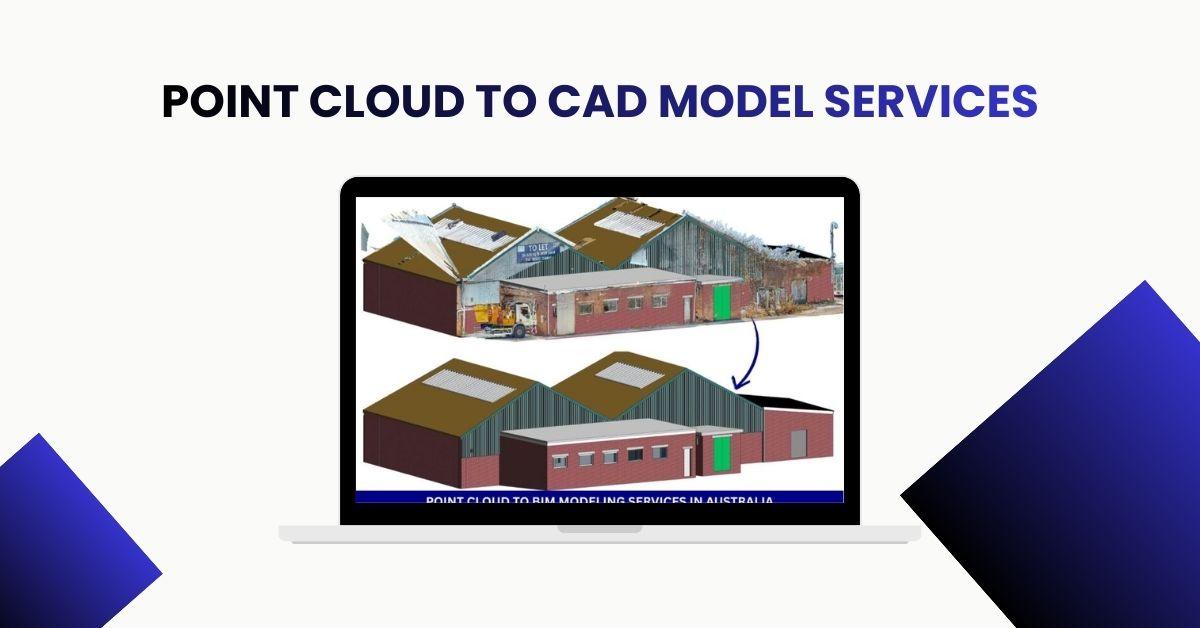
In today’s fast-paced construction and engineering industry, precision is no longer optional — it is essential. Point Cloud to CAD Model Services have become a critical solution for converting real-world site data into highly accurate 2D and 3D CAD drawings, enabling better planning, faster decision-making, and reduced project risks.
This technology bridges the gap between physical spaces and digital design by transforming millions of laser-scanned data points into detailed CAD models that professionals can confidently work with.
What Are Point Cloud to CAD Model Services?
Point Cloud to CAD Model Services involve converting raw point cloud data, captured through 3D laser scanning or LiDAR technology, into structured CAD drawings or 3D models.
These services deliver precise representations of existing conditions, including:
-
Architectural layouts
-
Structural components
-
MEP systems
-
Site topography
The result is a clean, editable CAD file that forms the foundation for design, renovation, clash detection, and construction planning.
Why the Industry Is Rapidly Adopting This Technology
Traditional site measurement methods are slow, error-prone, and costly. In contrast, point cloud conversion offers:
1. Unmatched Accuracy
Point clouds capture real-world geometry with millimeter-level precision, ensuring CAD models reflect true site conditions.
2. Time & Cost Efficiency
Automated data capture and digital processing significantly reduce manual surveying time and eliminate rework caused by inaccurate drawings.
3. Improved Collaboration
Teams across architecture, engineering, and construction can work from a shared, reliable digital model, improving communication and coordination.
4. Better Renovation & Retrofit Planning
Existing buildings often lack accurate drawings. Point Cloud to CAD services provide up-to-date documentation essential for renovations and expansions.
Key Applications of Point Cloud to CAD Modeling
Point Cloud to CAD Model Services are widely used across multiple industries:
-
Architecture – Creating as-built drawings and renovation models
-
Construction – Clash detection, layout verification, progress tracking
-
Engineering – Structural analysis and MEP coordination
-
Heritage Preservation – Digital documentation of historic structures
-
Industrial Facilities – Plant modeling, equipment placement, safety planning
The Conversion Process Explained
The transformation from raw scan data to a functional CAD model follows a structured workflow:
-
Data Collection – 3D laser scanning captures millions of data points
-
Data Registration & Cleaning – Aligning multiple scans and removing noise
-
Segmentation – Identifying walls, floors, beams, pipes, and other elements
-
CAD Modeling – Creating accurate 2D drawings or 3D CAD models
-
Quality Control – Verifying dimensions, alignments, and tolerances
-
Final Delivery – Providing editable CAD files in required formats
This systematic approach ensures every delivered model meets project and industry standards.
Why Outsource Point Cloud to CAD Model Services?
Outsourcing offers access to experienced specialists, advanced software tools, and faster turnaround times without the cost of maintaining in-house resources.
Key benefits include:
-
High-quality deliverables at lower operational cost
-
Scalable workforce for large projects
-
Faster project completion
-
Compliance with global CAD and BIM standards
Future of Point Cloud to CAD Model Services
As construction embraces digital transformation, the demand for accurate digital twins and reality capture solutions continues to grow. Integration with BIM, AI-driven modeling, and automated feature extraction will further improve efficiency and precision.
Companies that adopt Point Cloud to CAD Model Services today are positioning themselves for smarter, more sustainable project delivery in the future.
Conclusion
Point Cloud to CAD Model Services are revolutionizing how professionals document, design, and manage the built environment. By converting real-world data into reliable digital models, organizations achieve better accuracy, reduced costs, and stronger project outcomes.
Whether for new construction, renovation, or asset management, this technology has become a cornerstone of modern engineering and construction workflows.

 English
 Arabic
 French
 Spanish
 Portuguese
 Deutsch
 Turkish
 Dutch
Dutch
 Russian
 Romaian
 Portuguese (Brazil)
 Greek
Greek