
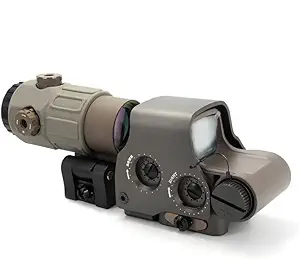
In the high-speed world of tactical shooting and professional optics, seconds feel like minutes. When you need to acquire a target instantly, the technology behind your glass is the only thing that matters. While traditional red dots have served the industry for years, the holographic sight has emerged as the gold standard for those who demand absolute precision under pressure.
At ARVR Optical, we specialize in the intersection of advanced laser technology and precision optoelectronics. Our experience in AR/VR optical modules gives us a unique perspective on how light is manipulated to create the perfect aiming point. Whether you are a first-time buyer or a specialized contractor, this guide will break down the complex science of holography into actionable information.
What is a Holographic Sight?
Unlike a standard red dot, which reflects an LED off a lens, a holographic sight uses a sophisticated laser diode to illuminate a hologram recorded inside the viewing window. This hologram contains the reticle pattern, which is suspended in 3D space rather than being projected onto a flat surface.
The result is a reticle that appears to "float" out at infinity. When you look through a holographic sight, your eye doesn't have to choose between focusing on the reticle and focusing on the target. You see both clearly at the same time, allowing for a "threat-focused" shooting style that is significantly faster than traditional methods.
How it Works: The Laser Engine
Inside every high-quality holographic sight provided by ARVR Optical, a laser reflects off a series of mirrors before hitting a holographic film. This film reconstructs the light into a complex reticle—usually a 1 MOA dot surrounded by a 68 MOA ring.
This laser-driven architecture provides three distinct technical advantages:
-
Parallax-Free Performance: Because the reticle is a reconstructed wavefront of light, it stays aligned with your target regardless of your eye's position. Even if you are looking through the corner of the window, the point of impact remains true.
-
No Point-of-Aim Shift: Since the reticle isn't a reflection on the front glass, the sight remains accurate even if the front window is shattered or covered in mud.
-
Magnification Clarity: When you add a magnifier behind a holographic sight, the center dot stays a crisp 1 MOA. In a standard red dot, the dot grows with the magnification, often obscuring the target at long distances.
Holographic Sight vs. Red Dot: Which is Right for You?
Buyers often ask why they should invest more in a holographic system. While red dots are excellent for their battery life and simplicity, the holographic sight is engineered for "high-stress" environments.
| Feature | Red Dot Sight (LED) | Holographic Sight (Laser) |
| Reticle Tech | LED Reflection | Laser-Generated Hologram |
| Eye Focus | Focus on Reticle or Target | Target-Focused (Both Clear) |
| Astigmatism | Often appears "fuzzy" | Stays crisp and sharp |
| Magnification | Dot grows with magnification | Dot stays precise (1 MOA) |
| Durability | Non-functional if glass breaks | Works even with broken glass |
Professional Applications in 2026
As we move through 2026, the application of holographic optics is expanding beyond the military sector.
-
Law Enforcement: Officers use these sights for rapid transitions between close-quarters environments and outdoor perimeter control.
-
Competitive Shooting: In speed-based disciplines, the 68 MOA outer ring allows for instant "coarse" aiming, while the 1 MOA center dot provides the precision needed for distant plates.
-
Search and Rescue: Integrating holographic reticles with night vision and thermal sensors allows rescue teams to maintain a clear point of aim while navigating dark or smoke-filled buildings.
-
Advanced Manufacturing: The same technology used in a holographic sight is now being used by ARVR Optical to develop industrial AR glasses that project assembly instructions directly onto physical machinery.
Technical Specs for the Expert Buyer
When sourcing a holographic sight, you must look beyond the rugged housing. At ARVR Optical, we recommend checking these three professional-grade specs:
-
Transmission Efficiency: High-quality holographic film should allow for nearly 100% light transmission. This ensures your view is bright and clear, even when using night vision devices.
-
Battery Management: Because lasers require more power than LEDs, look for sights with "auto-off" sensors and "shake-awake" technology to maximize operational time.
-
Reticle Brightness Settings: A professional sight should offer at least 20 brightness settings, including at least 10 specifically calibrated for use with generation III night vision.
Why ARVR Optical?
At ARVR Optical, we don't just understand optics; we understand the science of light. Our background in optoelectronics allows us to source and recommend only the most stable laser diodes and clearest holographic films. We know that in your world, "close enough" isn't an option. Our components are designed to hold zero through thousands of rounds of heavy recoil and extreme temperature shifts, from -40°C to +65°C.
Conclusion
The holographic sight is more than just an aiming tool; it is a piece of advanced semiconductor and laser technology designed to bridge the gap between human intent and mechanical precision. By providing a parallax-free, target-focused visual, it allows shooters to perform at their absolute peak, regardless of the conditions.
As we look toward the future of 2026, the integration of digital overlays and smart ballistics into holographic windows will continue to redefine the industry. Whether you are protecting a perimeter or pursuing a hobby, ARVR Optical is here to ensure you have the clearest vision possible. Precision isn't just about the shot you take; it's about the technology that lets you take it with confidence.

 Arabic
 French
 Spanish
 Portuguese
 Deutsch
 Turkish
 Dutch
Dutch
 Italiano
 Russian
 Romaian
 Portuguese (Brazil)
 Greek
Greek