
High-speed machining demands absolute thermal stability, yet many B2B workshops face "dimensional drift" as the workday progresses. This shifting accuracy is usually a sign that your spindle bearings are generating excessive heat.
In my years as a manufacturer, I have found that improper preload on the 70 series is the primary cause of premature failure. If the tension is too high, the balls "plow" through the lubricant, leading to a rapid temperature spike.
Solving these precision gaps requires a transition to high-precision matched sets with optimized contact angles. By choosing the right internal geometry, you can eliminate the vibration that ruins surface finishes on expensive workpieces.
The Challenge of Axial Thrust in 70 Series Bearings
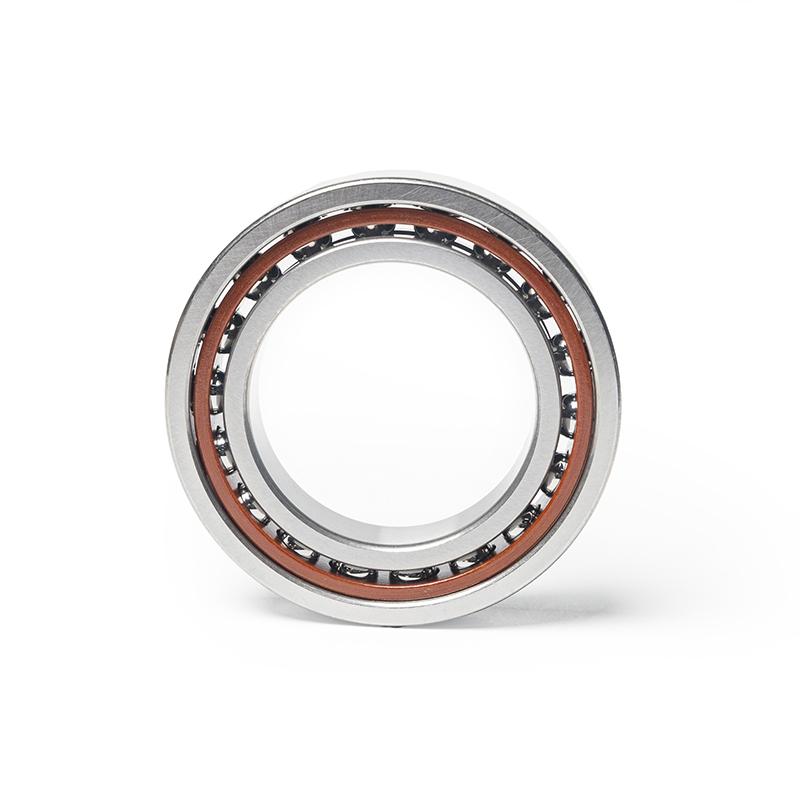
The 70 angular contact ball bearing is a staple in the B2B world for a reason: its ability to handle high speeds while supporting significant axial loads. However, a common problem occurs when the axial thrust is underestimated. If the force exceeds the bearing's contact angle capacity, the balls will ride up on the shoulder of the raceway. This creates "pitting" and microscopic metallic debris that quickly destroys the smooth surface of the race.
When diagnosing spindle noise or loss of accuracy, look for these specific indicators:
-
High-Frequency Whine: This often points to "skidding," where the balls slide instead of rolling because the axial load is too low to maintain contact.
-
Rapid Temperature Rise: Usually a symptom of a mismatched duplex set where one bearing is carrying 90% of the load.
-
Axial Play: A sign that the preload has diminished due to wear or a loose locknut.
Solving the Contact Angle Mismatch
Not all 70 series bearings are created equal. The contact angle (typically 15°, 25°, or 40°) dictates how the bearing handles force.
-
15° (Suffix C): The gold standard for high-speed spindles. It generates the least amount of heat but has the lowest axial capacity.
-
25° (Suffix AC): A versatile choice for B2B applications requiring a balance of speed and rigidity.
-
40° (Suffix B): Engineered for heavy-duty pumps and vertical shafts where the load is primarily in one direction.
If your spindle is failing under heavy cutting forces, switching from a 15-degree to a 25-degree angle can provide the structural stiffness needed to prevent the shaft from "deflecting" under load.
Precision Matching: The Secret to Long Life
Because these bearings are designed to take loads in only one direction, they are almost always used in pairs or sets. This is where "Universal Matching" becomes critical. If you buy two individual bearings that aren't factory-ground to be a matched pair, the internal clearances will differ.
When you tighten the mounting nut, one bearing will be under-loaded while the other is over-compressed. For high-end CNC applications, always specify P4 or P2 precision grades with universal matching. This ensures that the load is shared perfectly across all rolling elements, dampening vibration and extending the Mean Time Between Failures (MTBF).
Lubrication Management for High RPMs
Grease is often the first choice for convenience, but at the speeds 70 series bearings operate, "grease life" is a major factor. As the bearing heats up, the base oil separates from the thickener. If the oil runs out, the bearing will "seize" within minutes.
To solve this for B2B industrial environments:
-
High-Speed Synthetic Grease: Use a grease with a low "Nm factor" to minimize churning.
-
Oil-Air Mist: For ultra-high speeds (above 20,000 RPM), an air-oil system is necessary to keep the rolling elements cool and clear of debris.
-
Correct Fill Volume: Never "pack" a high-speed bearing full of grease. A 20-30% fill is usually ideal to prevent overheating from internal friction.
Material Upgrades: Ceramic vs. Steel
If your application is pushing the limits of heat and speed, consider hybrid angular contact bearings. These use silicon nitride (ceramic) balls with steel races. Ceramic is 40% less dense than steel, which drastically reduces the centrifugal force on the outer race at high speeds. This allows for higher RPMs and lower operating temperatures, solving the "thermal runaway" problem that plagues all-steel sets in heavy-duty B2B cycles.
Conclusion
As a premier manufacturer and supplier, Yuwei Bearing provides high-precision 70 series solutions that eliminate spindle drift. Trust our factory-direct expertise for your B2B needs.

 English
 Arabic
 French
 Spanish
 Portuguese
 Deutsch
 Turkish
 Dutch
Dutch
 Italiano
 Russian
 Romaian
 Portuguese (Brazil)