
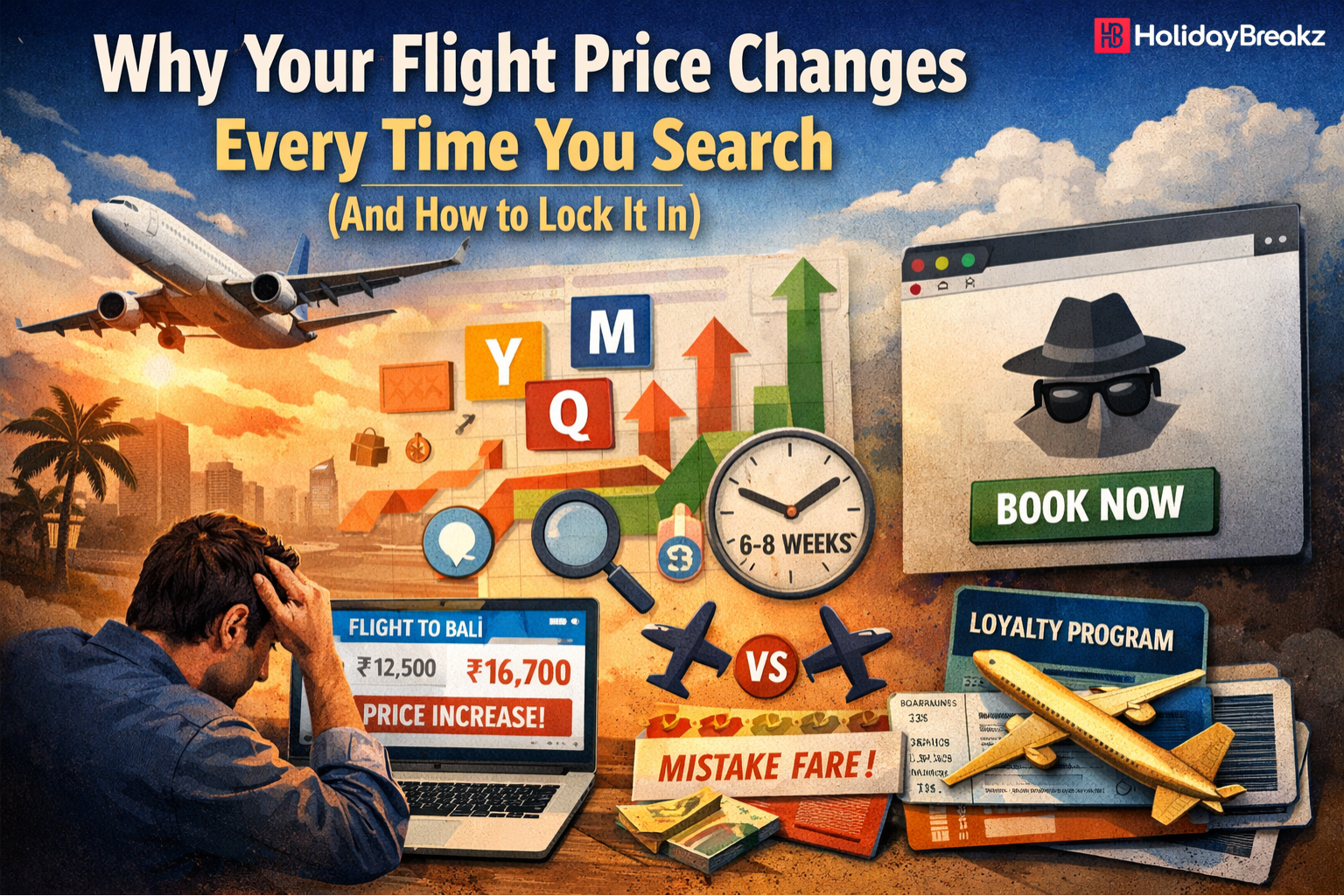
You've done it. Found what looks like the perfect flight — a reasonable price to your dream destination, a sensible departure time, maybe even a window seat. You close the tab to think it over. Twenty minutes later you're back, credit card in hand, ready to book.
The price is now ₹4,200 higher.
This moment of quiet rage is so universal it's practically a rite of passage for modern travellers. But it isn't random, it isn't a glitch, and it most certainly isn't a coincidence. There is a sophisticated, algorithmically driven system working behind the scenes — and once you understand how it works, you can start working it to your advantage.
What Is Dynamic Pricing and Why Do Airlines Use It?
Airlines don't sell tickets the way a grocery store sells milk. They use a system called Revenue Management — a branch of operations research that originated at American Airlines in the 1980s and has since become one of the most advanced pricing disciplines on the planet.
At its core, revenue management is about selling the right seat to the right person at the right price at the right time. Airlines know their planes have a fixed capacity. Every seat that flies empty is revenue lost forever. But selling every seat cheaply means leaving money on the table from passengers who would have paid more. The goal is to maximise total revenue across every seat on a given flight.
To achieve this, airlines divide their inventory into fare classes — sometimes called booking classes or fare buckets. Each fare class is assigned a letter code (Y, B, M, K, Q, and so on), a specific price, and a limited number of seats. The cheapest fare class might have only four seats available. Once those sell, the next class opens at a higher price. And so on, all the way up to the most expensive fully flexible tickets.
The key insight here is important: when you see a price change between searches, the cheapest fare class has likely sold out — or been closed by the airline's algorithm — and the next pricing tier is now the lowest available option. You're not seeing a new price. You're seeing a different product entirely.
The Algorithm That Watches You Back
Beyond fare buckets, airlines and booking platforms use real-time demand signals to constantly reprice inventory. These signals include several key factors.
Search volume and conversion rates play a significant role. Booking platforms track how many users are searching for a given route on a given date. A sudden spike in searches — triggered by a news story, a festival announcement, or a viral social media post — can cause prices to rise within hours. The algorithm interprets high search volume as high demand and adjusts pricing accordingly.
Booking velocity is another powerful signal. If seats on a flight are selling faster than the historical average for that route, the revenue management system interprets this as an indicator that demand exceeds supply. It will close lower fare classes early and push inventory into higher-priced buckets, even if the flight is months away.
Time to departure is perhaps the most well-known factor. Airlines model the probability that unsold seats will eventually fill. Early in the booking window, they can afford to offer lower prices to stimulate early demand. As departure approaches, the unsold seat becomes a ticking clock — and prices typically rise sharply to capture last-minute travellers, particularly business passengers who have little choice but to pay.
Competitive pricing also drives constant adjustments. Airlines monitor competitors' fares in near real-time through systems like ATPCO (Airline Tariff Publishing Company). If a rival drops their fare on a competing route, an airline's algorithm may automatically match or undercut it — sometimes within minutes. The reverse is equally true.
Are Airlines Actually Tracking You Personally?
This is the great internet myth of flight searching: that airlines raise prices when they detect you've searched the same route multiple times, using cookies or browser history to identify you as a motivated buyer.
The reality is more nuanced. There is no credible, peer-reviewed evidence that airlines systematically raise prices based on an individual's browsing history. However, there are legitimate reasons why opening a private or incognito browser window might occasionally show you a slightly different price.
Your IP address can reveal your approximate location, and some airlines and Online Travel Agencies do show different prices to users in different markets — a practice called geo-pricing. Additionally, airlines file different fares for different regional markets, so a ticket booked through an Indian point-of-sale may genuinely be priced differently from the same ticket booked through a US or European point-of-sale. Finally, a booking platform may show you a fare from its cache that is a few minutes old. Refreshing in a private window forces a fresh data pull and may display the current live price.
The most reliable reason to use incognito mode isn't to outsmart pricing algorithms — it's to ensure you're seeing the most current, uncached fares. It's a data hygiene trick, not a magic discount generator.
The Day-of-Week and Time-of-Day Effect
Flight prices are not equally distributed across the week or across the day. Years of aggregated booking data reveal consistent patterns that savvy travellers regularly exploit.
Historically, Tuesdays and Wednesdays have shown lower average fares, particularly for domestic routes. Airlines often announce sales on Monday evenings, and by Tuesday morning competitors have matched them, creating a brief window of lower prices before leisure travellers spot and book those deals through the week.
For departure days, the cheapest options consistently cluster around Tuesday, Wednesday, and Saturday for most routes. Friday evening and Sunday evening flights command premiums because they align with business travel and the return leg of weekend trips. If you have schedule flexibility, shifting your travel by even one or two days can produce savings of 15–25% on popular domestic routes.
The Booking Window: Too Early, Too Late, and the Sweet Spot
One of the most practically useful things you can understand about flight pricing is the booking curve — the relationship between how far in advance you purchase and what you pay.
For domestic Indian routes, the data consistently points to a sweet spot of around four to eight weeks before departure. Booking earlier than this puts you in the airline's demand stimulation phase, but the absolute cheapest fares often appear around six weeks out, not three months out. Booking within two weeks of departure almost always means paying a significant premium.
For international flights from India — whether to Southeast Asia, the Middle East, Europe, or North America — the optimal window expands considerably. Booking three to six months in advance is the general sweet spot, with the best fares for peak-season travel (summer holidays and December) often appearing six to nine months ahead.
The "book as early as possible" advice is a half-truth. What you actually want is to book within the airline's optimal demand stimulation window — which is rarely the day tickets go on sale.
Why Round-Trip Fares Aren't Always Twice a One-Way
Here's a quirk that catches out even experienced travellers. For many routes and airlines, the pricing logic for round-trip tickets is not additive. The fare for a return journey is filed as a single combined fare with its own rules, minimum stay requirements, and availability conditions. It doesn't simply equal outbound plus inbound.
This means a round-trip ticket is sometimes cheaper than two one-way tickets. It also means that booking two separate one-way tickets on different carriers — a strategy sometimes called a hacker fare — can occasionally be cheaper than a combined round-trip, particularly if one airline is running a sale on one leg. The risk is that if you miss your connection, the second carrier has no obligation to rebook you at no extra cost.
Practical Strategies to Lock In a Good Fare
Understanding why flight prices change is only half the battle. Here's how to act on that knowledge.
Use fare alerts instead of repeated searches. Set a fare alert on Google Flights, Skyscanner, or your preferred booking platform. You'll be notified when the price crosses your target threshold, and you won't risk triggering demand signals through excessive searching.
Be flexible on dates and use the calendar view. Most major search engines now display fares across a range of dates simultaneously. Shifting your travel by even one day can produce dramatic savings. Flexibility is your single most powerful fare-finding tool.
Search nearby airports. The difference in fares between Mumbai and Pune for an international departure, or between Delhi and Chandigarh for a domestic connection, can be meaningful. Always check whether a nearby airport offers a better deal once you factor in ground transport time and cost.
Use multiple comparison tools, then book direct. Aggregator sites are excellent for discovery and comparison. But once you've identified your ideal flight, check the airline's own website too. Airlines sometimes offer website-exclusive fares, bonus miles, or complimentary seat selection that aggregators don't always surface.
Compare total costs, not headline prices. A ₹4,500 fare with ₹800 in baggage fees and ₹200 for seat selection is more expensive than a ₹5,200 all-inclusive fare. Low-cost carriers have mastered the art of the attractive base price that mushrooms into a much higher total. Always compare what you'll actually pay at checkout.
Mistake Fares: When the System Glitches in Your Favour
Occasionally, human error or system glitches produce what the industry calls mistake fares — absurdly cheap tickets that slip through before airlines catch them. A ₹8,000 business-class fare to London. A ₹1,200 round-trip to Bali. These exist, and dedicated communities of travellers have built entire travel lifestyles around finding them.
Airlines are not legally obligated to honour mistake fares in all jurisdictions, and some do cancel bookings made at erroneous prices. However, once a ticket is properly issued with an e-ticket number, most airlines choose to honour it to avoid the reputational damage of cancellation. Speed is everything — mistake fares are typically corrected within a few hours of being spotted.
Loyalty Programs: The Long Game That Changes the Maths
If you fly more than a few times a year, ignoring airline loyalty programs means leaving real money behind. Frequent flyer miles earned on paid tickets can translate into free flights, cabin upgrades, and lounge access — effectively reducing the true cost of every ticket you purchase.
The strategic use of co-branded airline credit cards, which earn miles on everyday spending, has become one of the most potent tools available to Indian travellers. Concentrating your flying with one or two alliance partners, maximising card spending, and redeeming points for high-value awards — particularly international business class, where redemptions deliver the greatest value — can fundamentally transform your relationship with airfare pricing.
Your Complete Booking Playbook
Putting everything together, here is a practical approach to booking flights that removes emotion and replaces it with strategy.
Start tracking fares early — three to six months ahead for international travel, six to eight weeks for domestic. Use the calendar view to identify the cheapest dates within your window of flexibility. Compare total costs across at least two or three search platforms. Check the airline's own website for exclusive deals. Book when you find a fare within your target range, rather than waiting indefinitely for a lower price that may never arrive.
For planning your next trip with full fare transparency and a wide range of flight and holiday options, HolidayBreakz is a great starting point to compare deals and take the guesswork out of booking.
The Bottom Line
The next time you watch a flight price tick upward between searches, you'll know exactly what's happening. A fare bucket has closed. An algorithm has recalculated demand. A competitor has adjusted. The system is working precisely as designed.
And now, armed with a clear understanding of how it works, you're finally equipped to work it back.
Book smart. Fly often. Pay less.

 English
 Arabic
 French
 Spanish
 Portuguese
 Turkish
 Dutch
Dutch
 Italiano
 Russian
 Romaian
 Portuguese (Brazil)
 Greek
Greek